Services / E-delivery notes
Electronic delivery notes for companies in Serbia
Serbian electronic delivery notes, two ways: I connect your software to the government e-delivery note system, or you work in my portal with no ID card reader and no personal ID for every document. The service I built for the BKC Soft point of sale software has sent more than 5,000 delivery notes so far.
- delivery notes sent through the BKC Soft service
- 5,000+
- free use of the portal
- 3 months
- obligation for all private sector companies
- Oct 1, 2027
Serbian electronic delivery notes: the portal or a connection for your software
Sending and receiving delivery notes
Outgoing notes go to your customers; incoming ones from suppliers are fetched for a chosen period of 3, 5, 7 or 10 days, or manually.
Receipt confirmations
Incoming and outgoing receipt notes, the confirmations that goods arrived, each with its status.
No card reader
The company enters its API key from the government system once, and it is stored encrypted (AES-256-GCM). After that anyone with an account can send, not only the person whose ID card sits in the reader.
Items from the fiscal receipt
Nobody types the items: the portal reads the QR code on a fiscal receipt and pulls the lines and quantities from the Tax Administration system.
Checks before sending
Every delivery note is checked against the government validator before it is sent, so mistakes are fixed while it can still be changed.
Excise goods
The portal also handles delivery notes for excise goods, where the obligation applies from January 1, 2026.
Driver, vehicle and location lists
Drivers, vehicles and locations are entered once. Recipients are found by name or tax number in the register of companies.
Works on a phone
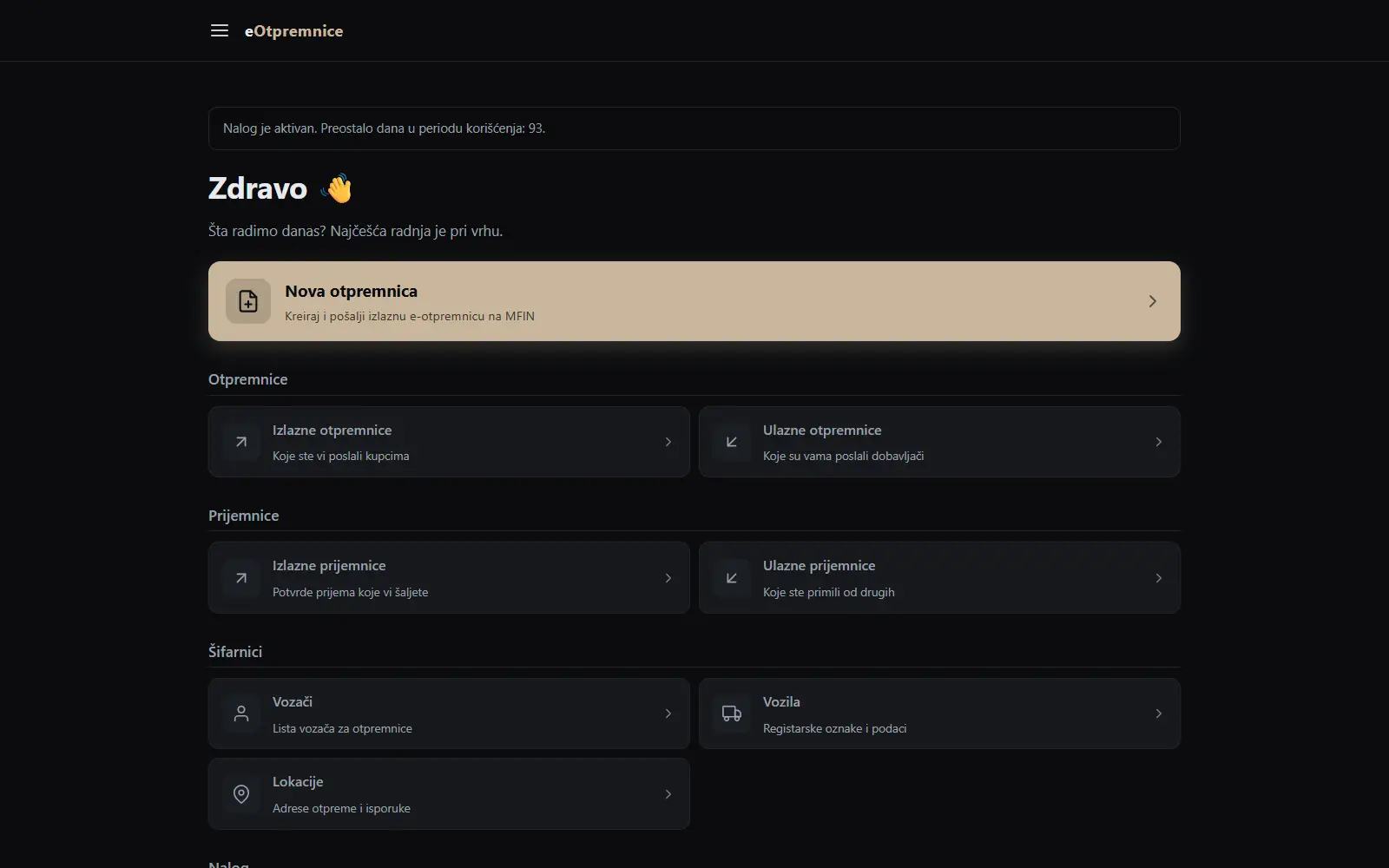
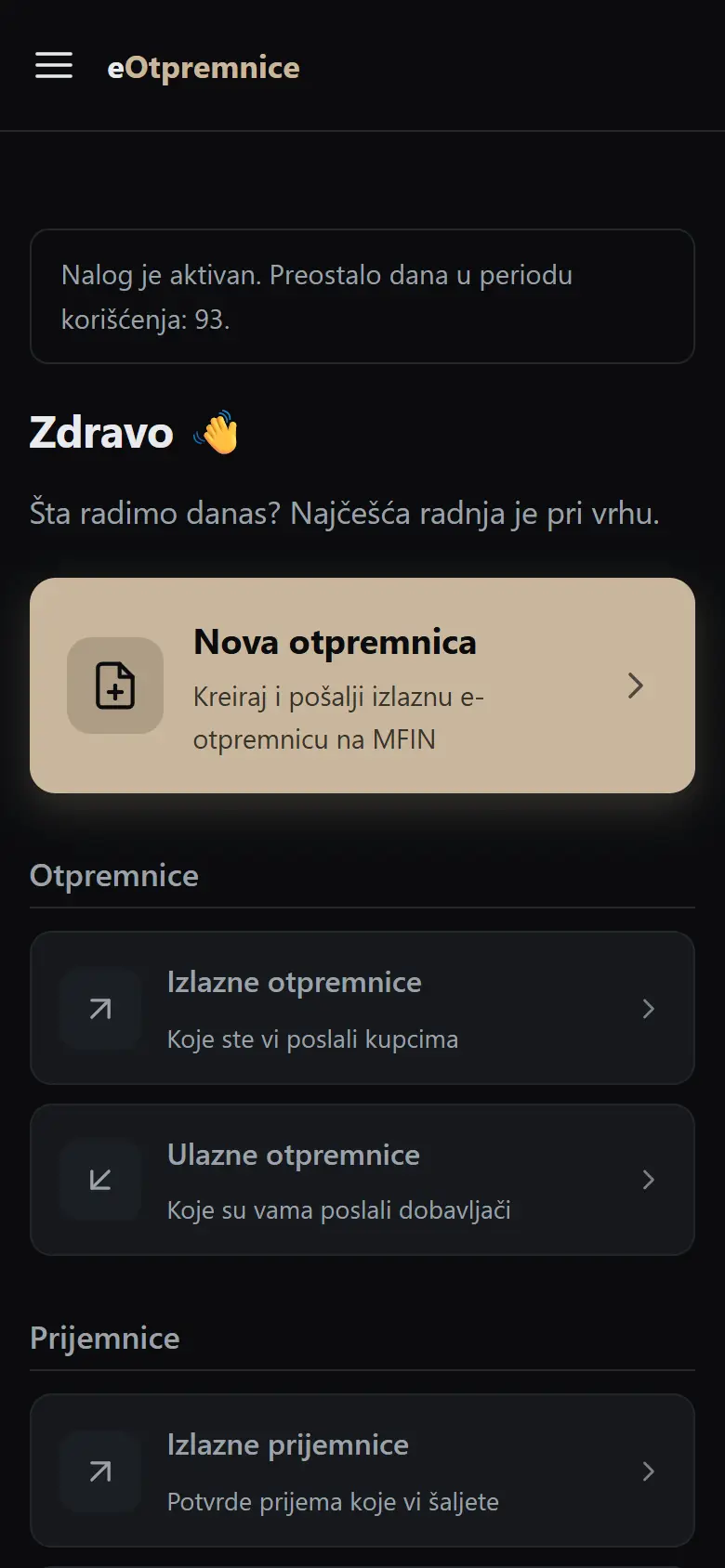
The whole portal works on a phone, and a new delivery note is the first button on the dashboard.
Who this is for, and who it is not for
A good fit if you
- ship goods in Serbia several times a day and dispatch depends on one person and their ID card in a reader.
- run point of sale or warehouse software that already knows the goods, so it should create the delivery note itself, like BKC Soft.
- sell excise goods or supply the public sector in Serbia, where the obligation has applied since January 1, 2026.
Not a fit if you
- provide services only, with no movement of goods. The law covers delivery notes for goods in transit.
- are a private individual without a registered business; the law does not apply to you.
- need a software connection within days. An integration takes 20 days or more; the portal works immediately.
How I work
- 01
Portal or integration
No software that creates delivery notes? The portal is faster. Otherwise, let your software create them.
- 02
Portal: right away
Register the company, enter the API key and start sending. The first 3 months are free.
- 03
Integration: your software
Tell me the name of the software and who maintains it. Messages sent before 5 pm CET get a same day reply.
- 04
An API for your software
I build an API your software calls to send or fetch a delivery note, or connect it directly.
- 05
Test on the demo system
The whole flow runs through the Ministry of Finance demo environment before the first real delivery note.
- 06
Law changes
I follow every amendment as it is published, build it in and test it on the demo environment.
Deadlines under the Law on Electronic Delivery Notes
The Serbian Law on Electronic Delivery Notes was passed in November 2024 and has been amended twice since, most recently in August 2026. The obligation comes in two phases:
| Obligation | Applies from |
|---|---|
| public sector sends and receives electronic delivery notes | January 1, 2026 |
| private sector sends delivery notes to the public sector | January 1, 2026 |
| excise goods: sending and receiving in the private sector | January 1, 2026 |
| rules on electronic delivery notes in paper form | April 1, 2026 |
| private sector receives electronic delivery notes for every movement of goods | October 1, 2027 |
| sending between two private sector companies | October 1, 2027 |
The August 2026 amendment (Official Gazette no. 80/2026) states that until January 1, 2027, data errors in sent delivery notes and receipt notes are not taken into account in inspections. A delivery note sent by a private sector company is kept in the system for 10 years from the end of the year it was sent. Check with your accountant what applies to your company; my job is making sure the software or the portal handles it correctly. Registration and common mistakes are covered in the e-delivery notes guide.
A real example: the e-delivery notes portal
Access to the government system goes through a qualified certificate on a personal ID card: a card reader on the computer and that exact person present for every document. A company that ships several times a day ties the whole process to one person. If they are out on the road, shipping stops.
In the portal, a company enters its API key once and then sends delivery notes, receives incoming ones, issues receipt notes and keeps records, from a phone too. Items come in by scanning the QR code on a fiscal receipt, and the government validator catches errors before sending.
The other route is connecting existing software. The BKC Soft point of sale software sends delivery notes through a service I built, and more than 5,000 have gone through it so far, without anyone opening a separate portal.
5,000+
delivery notes through the BKC Soft service
1
API key for the whole company, no card reader
3 months
free in the portal
Technology and why
The government system accepts delivery notes in UBL 2.1 (an international XML standard for business documents), through an API authenticated with the company's key, and the Ministry of Finance runs a separate demo environment for testing. The portal is built in PHP, MySQL and JavaScript and connects to three government systems: the e-delivery note system, the Tax Administration system for reading fiscal receipt items, and the government XML validator.
The BKC Soft service is written in Go, as a single executable the point of sale software calls on the same computer.
Pricing and timelines
The portal is free for the first 3 months. After that there is a monthly subscription, priced by the number of delivery notes sent. The portal works as soon as you register and enter the API key; its interface is in Serbian.
Connecting your software is quoted per project and starts at around 300 EUR. It takes 20 days or more, mostly depending on how quickly I get documentation and answers about your software. If you need a formal invoice, I issue it through a registered company and VAT is added.
E-delivery note questions
Do I need a card reader and a personal ID?
No. The company enters its API key from the government system once, and after that anyone with an account in the portal, or the connected software, can send.
From when does my company have to send electronic delivery notes?
For the public sector, deliveries to the public sector and excise goods, from January 1, 2026. For sending and receiving between private sector companies, from October 1, 2027.
How much does the portal cost?
The first 3 months are free. After that you pay a monthly subscription that depends on the number of delivery notes you send.
Can my own software send delivery notes directly?
If it can be extended to call an API I build, yes. The BKC Soft software has sent more than 5,000 that way. A connection is quoted per project, from around 300 EUR.
What if I make a mistake in a delivery note?
The portal checks each note against the government validator before sending, so most mistakes are caught early. Under the August 2026 amendment, data errors are not taken into account in inspections until January 1, 2027.
Does the portal handle e-invoices too?
Not yet, only delivery notes and receipt notes. An e-invoicing portal is in preparation, with the same 3 month trial. Until then, e-invoices from your own software go through a SEF e-invoicing integration, as at BKC Soft.
Sources (checked October 4, 2026)
- Electronic delivery notes system, eotpremnica.efaktura.gov.rs: official Ministry of Finance portal.
- Law on Electronic Delivery Notes, consolidated text with amendments (Official Gazette nos. 94/2024, 109/2025 and 80/2026), Articles 1, 11 and 16 and the transitional provisions of the amendments.
- Technical guide and API documentation.
- e-delivery notes portal, registration and free trial.
Try the portal or tell me about your software
Register for the portal and use it free for the first 3 months. For a software connection, tell me which software you use and who maintains it; messages sent before 5 pm CET get a same day reply.