Court interpreter website / 2025
Turkish court interpreter: a three language site with a guide before the enquiry
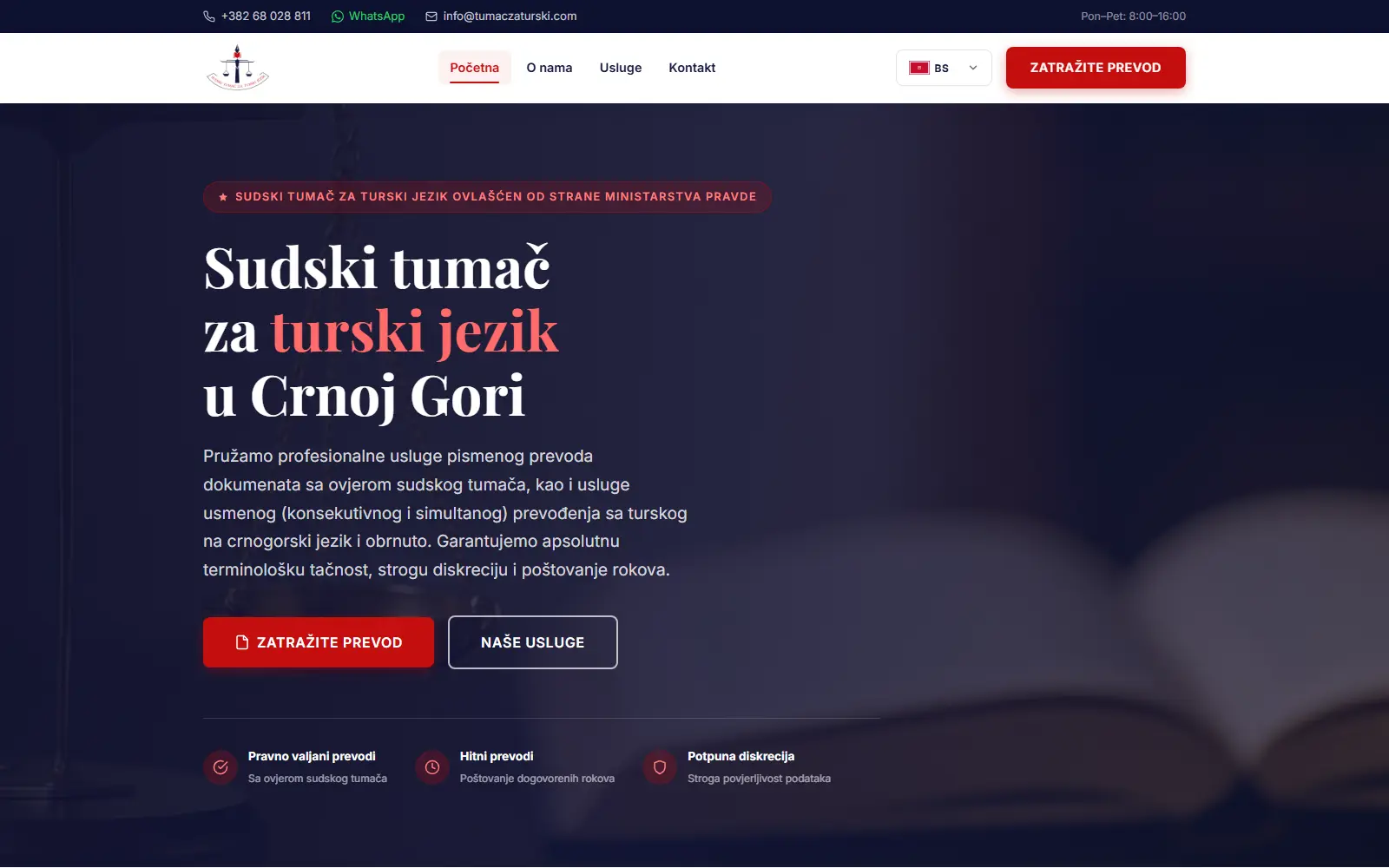
Case study: a site for a Turkish court interpreter in Montenegro, in Bosnian, English and Turkish, with a PDF document guide. 10+ enquiries a month.
- Client
- Tumač za turski
- Year
- 2025
- Build time
- one week
- Role
- Website, copy, PDF guide and maintenance
- Technologies
- PHP, MySQL, JavaScript, HTML
10+
enquiries a month, by email and WhatsApp
3
languages: Bosnian, English and Turkish
7 days
to build the site
This is a case study of the website of a court interpreter for Turkish in Montenegro. If you need a certified translation from or into Turkish, the official site is tumaczaturski.com.
Client and context
The client is a court interpreter for Turkish, appointed by the Ministry of Justice of Montenegro and based in Podgorica. The work covers certified written translation of documents, consecutive and simultaneous interpreting at trials, meetings and notaries, and urgent translation. I built the site in 2025, in one week. It is a presentation site with no admin panel, and I have maintained it since.
Problem
A certified translation is usually needed under deadline pressure and with unclear instructions from the institution asking for it. Someone looking for a court interpreter for the first time does not know what a certified translation is, which documents to bring, in what form, or how long it will take. If the site does not tell them, they call and ask first, and only then send the document.
The second part of the problem is language. For a court interpreter, language is not a sales channel; it is the service itself. Some clients are native Turkish speakers, so a site only in Bosnian would make little sense.
Constraints
Nothing was technically complicated: it is a presentation site with a few pages. The constraint was the Turkish copy. On a court interpreter's website the translation has to be legally and grammatically exact, so I did not translate the Turkish parts myself. I put together the structure and all the copy, and the interpreter translated parts into Turkish and sent them to me. That is why the Turkish version took longer than the rest of the site: I waited for an exact translation, not a fast one.
Solution
Three languages, each with its own URLs
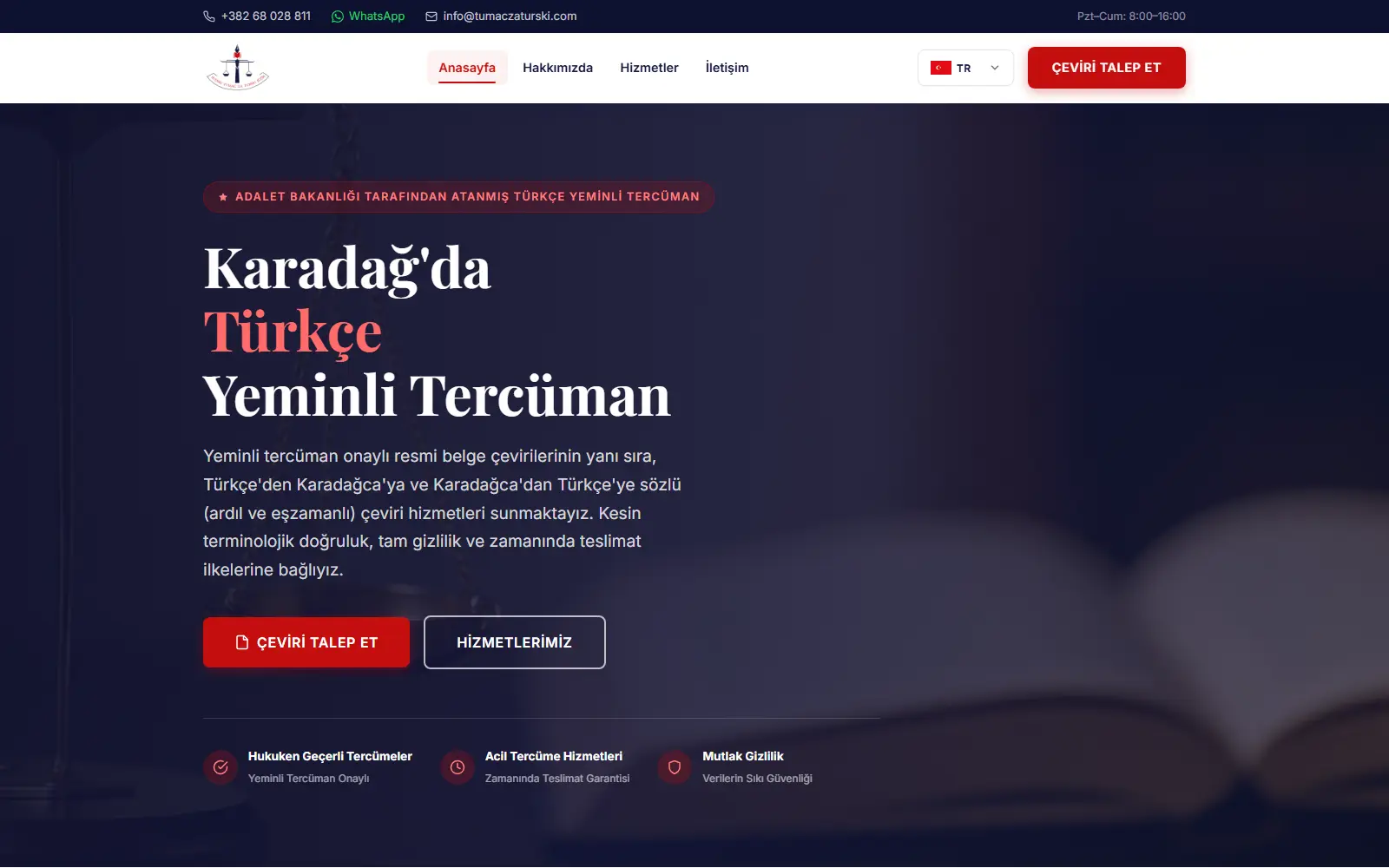
The site runs in Bosnian, English and Turkish. Bosnian is the default, and the English and Turkish versions have their own URLs (/en/ and /tr/). The language is chosen in the header, with a flag and the language name. The Turkish version is not a word for word translation: its headline reads "Karadağ'da Türkçe Yeminli Tercüman" (sworn Turkish translator in Montenegro), the usual Turkish term for a court interpreter, rather than a literal rendering of the Bosnian headline.
Services split the way people ask for them
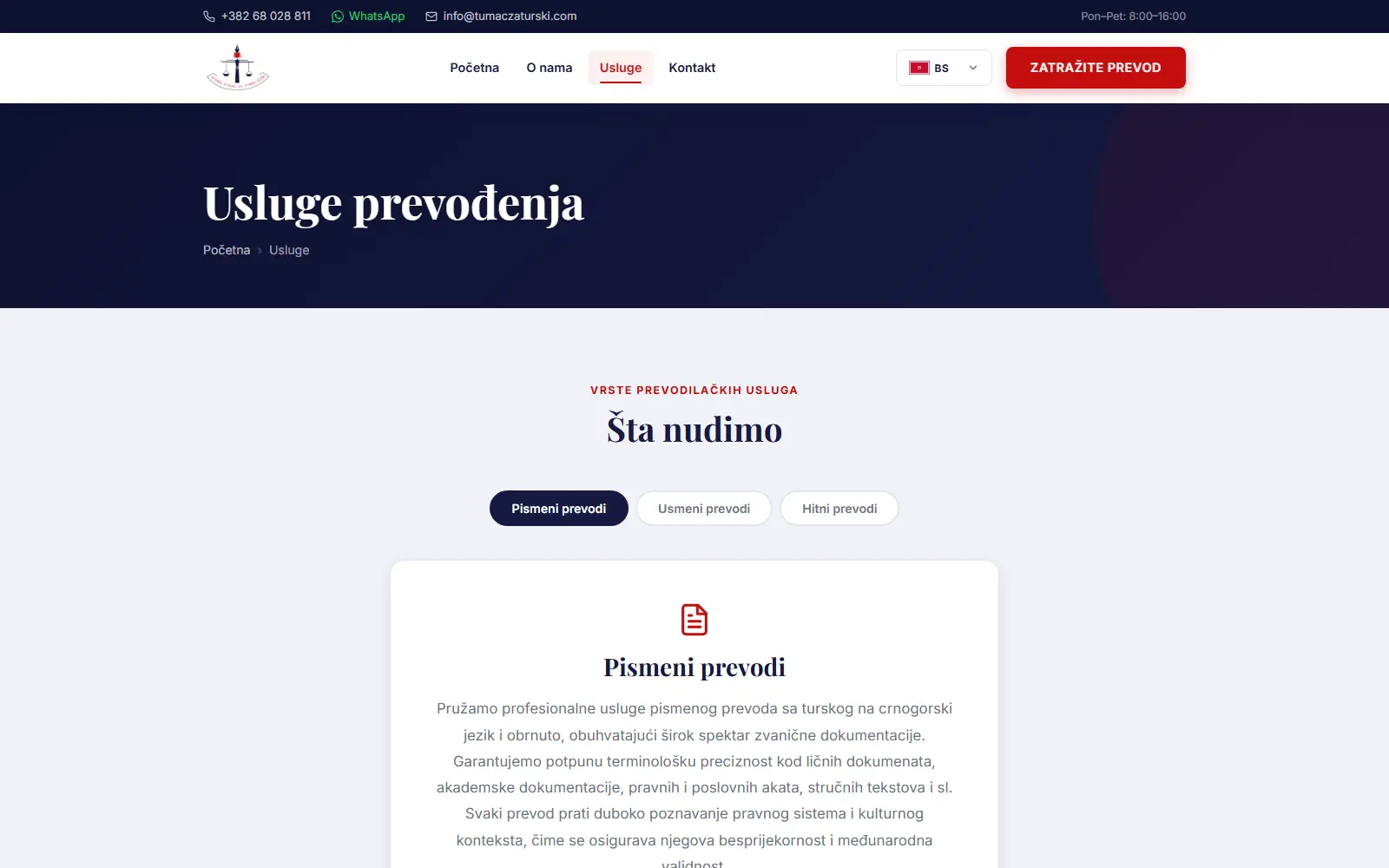
Certified written translation and interpreting are separate, because people ask for them separately. On the services page, visitors choose between written, oral and urgent translation and read only what concerns them. For urgent work the site states plainly that it is done to an agreed deadline with a surcharge for urgency.
Documents listed by type
Visitors often do not know whether their document can be translated at all, so documents are grouped: court documents (judgments, decisions, lawsuits, powers of attorney), education documents (diplomas, school certificates, transcripts), personal documents (civil registry extracts, certificates, passports) and medical documents (specialist reports, discharge summaries).
A PDF guide before the form
A separate part of the site is the guide to preparing documents, which I made as a downloadable PDF. It sits before the form, so visitors first learn what they need and only then send a request. The guide has five parts:
- which documents can be translated, in the same groups as on the site, plus business documents (contracts, invoices, company register extracts);
- how to prepare a document: legible and complete, with no missing text or stamps, and scanned in high resolution as PDF or JPEG instead of a blurry phone photo;
- how to deliver it: in person, via WhatsApp, by email or by courier;
- turnaround: 1 to 3 working days as standard, urgent within 24 hours by arrangement and with a surcharge;
- whether a certified translation is legally valid, and contact details for delivery.
Contact on every page
Phone, WhatsApp and email sit in the top bar of every page, along with opening hours (Monday to Friday, 8:00 to 16:00). The button to request a translation is in the header and in the first screen of the home page. The form on the contact page asks for name, email, phone and type of service (written, oral, urgent or other), and for urgent requests the site points visitors straight to the phone or WhatsApp, to agree on the deadline.
What a client learns before the first enquiry
| Client's question | Where the answer is |
|---|---|
| What is a certified translation? | the "What is a certified translation?" section on the home and services pages |
| Do you translate my document? | the list of documents by type and the PDF guide |
| How do I send the document? | PDF guide: in person, WhatsApp, email or courier |
| How long will it take? | PDF guide: 1 to 3 working days, urgent within 24 hours |
| Can I do this in Turkish? | the Turkish version of the site, at /tr/ |
The site answers these questions before the client gets in touch, so the form and WhatsApp are used for the document itself and for agreeing on the deadline.
Technologies and why
The site is built in PHP, MySQL, JavaScript and HTML. A presentation site with a few pages in three languages needed nothing more: what mattered was that each language version has its own URLs and titles for Google, that contact details are visible at once, and that the guide can be downloaded without sending an enquiry.
Result
The site brings in more than 10 enquiries a month, by email and WhatsApp, and the number is slowly growing. The guide and the document list are there so that an enquiry starts with the document, not with "what do I need" (as of October 2026).
Inside the application
Services used on this project
- Website development for companies that want enquiries
- Website maintenance after launch
- Web design that starts on the phone
Questions about the project
Who was this website built for?
A court interpreter for Turkish in Montenegro, based in Podgorica. This is a case study of the website; the official site is tumaczaturski.com. The site's name, Tumač za turski, means Turkish interpreter.
Why does the site have a Turkish version?
Because Turkish is the service itself. Some clients are native Turkish speakers, and they look for an interpreter in their own language.
What is in the PDF guide?
Which documents can be translated, how to prepare them (legible and complete, scanned as PDF or JPEG), how to deliver them, how long it takes and whether a certified translation is legally valid. Clients learn this before they send an enquiry.
Who wrote the Turkish copy?
I put together the structure and all the copy, and the interpreter translated parts into Turkish, because on a court interpreter's website the translation has to be both legally and grammatically exact.
Does the site have an admin panel?
No, because it is a presentation site whose content rarely changes. I make changes to the copy or the PDF guide myself, as part of maintenance, in all three languages.
What would a site like this cost?
A presentation site starts at 100 EUR and takes 3 to 7 days, and a second or third language adds a small surcharge. Prices are on the pricing page.
Similar projects
Case study
Galia Apartmani: a holiday apartments site with 10,000+ visits in season
Case study: a site for 14 holiday apartments in Bar in Serbian, English and German, with WhatsApp enquiries and destination pages. 10,000+ visits.
Case study
Bralić & Dekić: a website for the German market, built to German rules
Case study: a site for an installation firm in Germany, in German and English, with an Impressum, cookie consent and a German admin. Built in 15 days.
Got a similar job?
Describe what you need in a few sentences. Messages sent before 5 pm CET get a same day reply with an estimate of price and timeline.